Big Elm Hunting
Max Coleman, 10/08/2026
Having developed an interest in elms, and the rarity of their survival when Dutch elm disease runs unchecked, I have come to know quite a few interesting big elms in the Scottish Borders. It was recently pointed out to me that the details of many of these trees are not freely available, although Keith Knight and others have been adding wych elms (Ulmus glabra) to the Ancient Tree Inventory. The ATI seems the ideal platform for recording these trees and has the advantage that particularly old and biologically important trees, such as those with decay or rich communities of epiphytic lichens, can be flagged as veteran or ancient. As up-to-date guidance on elms still needs to be written this post gives a bit of background to raise awareness and encourage the recording of significant elms.
I first noticed large surviving elms in the mid-1990s in Lincolnshire in an area already devastated by the impact of Dutch elm disease. Nearly all the elms in this area were probably lost in the 1970s. I used to call elms the forgotten tree as most people considered elm to be a lost cause. However, now there is growing interest in elms. I am assisting the Scottish Plant Recovery project, run by the Royal Botanic Garden Edinburgh, with conservation of wych elm (Ulmus glabra). Our aim is to crossbreed surviving, large elms to produce a generation of saplings that have two apparently resilient parents rather than just one. This is an experimental approach to establish better-adapted elms in suitable, wilder parts of Scotland where they can spread naturally because deer density has been reduced, or the animals have been fenced out. In 2025, nearly 2,500 elm saplings from our breeding work were planted at more than 20 sites across Scotland, adding to a smaller trial in 2024.

Max Coleman and Keith Knight with the wych elm known as the Jedburgh Giant - photo credit Max Coleman
The John Innes Centre is running a programme of inoculation trials to quantify levels of disease resistance in a selection of elms, and the Royal Botanic Gardens Kew has just completed a study designed to look for evidence that there is a genetic basis to an elm’s disease response. This is like hunting for a needle in a haystack and it is still early days. At least research is now happening and new methods for exploring genetic variation are providing new opportunities to try and understand why some elms survive. Others are looking at the influence of regulation of gene activity and the role of an elm’s microbiome – the fungi and bacteria that can live within the trees cells in a relationship that is analogous to our gut ‘flora’. These microbes can keep trees healthy, and some may have a role in fighting disease.
There are also local community-driven initiatives to protect and conserve important surviving elms, such as the disease-free wych elms of Assynt in northwest Scotland, where a ‘story map’ about elms is being created to raise awareness, and the national collection of elms in Brighton. As a resident of Edinburgh, I feel duty bound to mention Edinburgh’s collection of tens of thousands of elms as they have existed in the shadow of Brighton’s elms for too long. Both cities have impressive mature elms due to the ongoing disease control carried out by the local authorities. These collections are artificially maintained and would be lost if control measures stopped. Nevertheless, those who preserve them should be congratulated as they include many fine specimens and rare kinds of elms and act as a reminder of what we have lost in nearly every other part of Britain.
For those unfamiliar with elms, as most people are these days, they are large trees with leaves that have characteristic unequal bases and small papery seeds that look like fried eggs and drift on the breeze in May. Sadly, due to the losses to disease, being caught in a ‘snowstorm’ of elm seeds is now a rare experience.

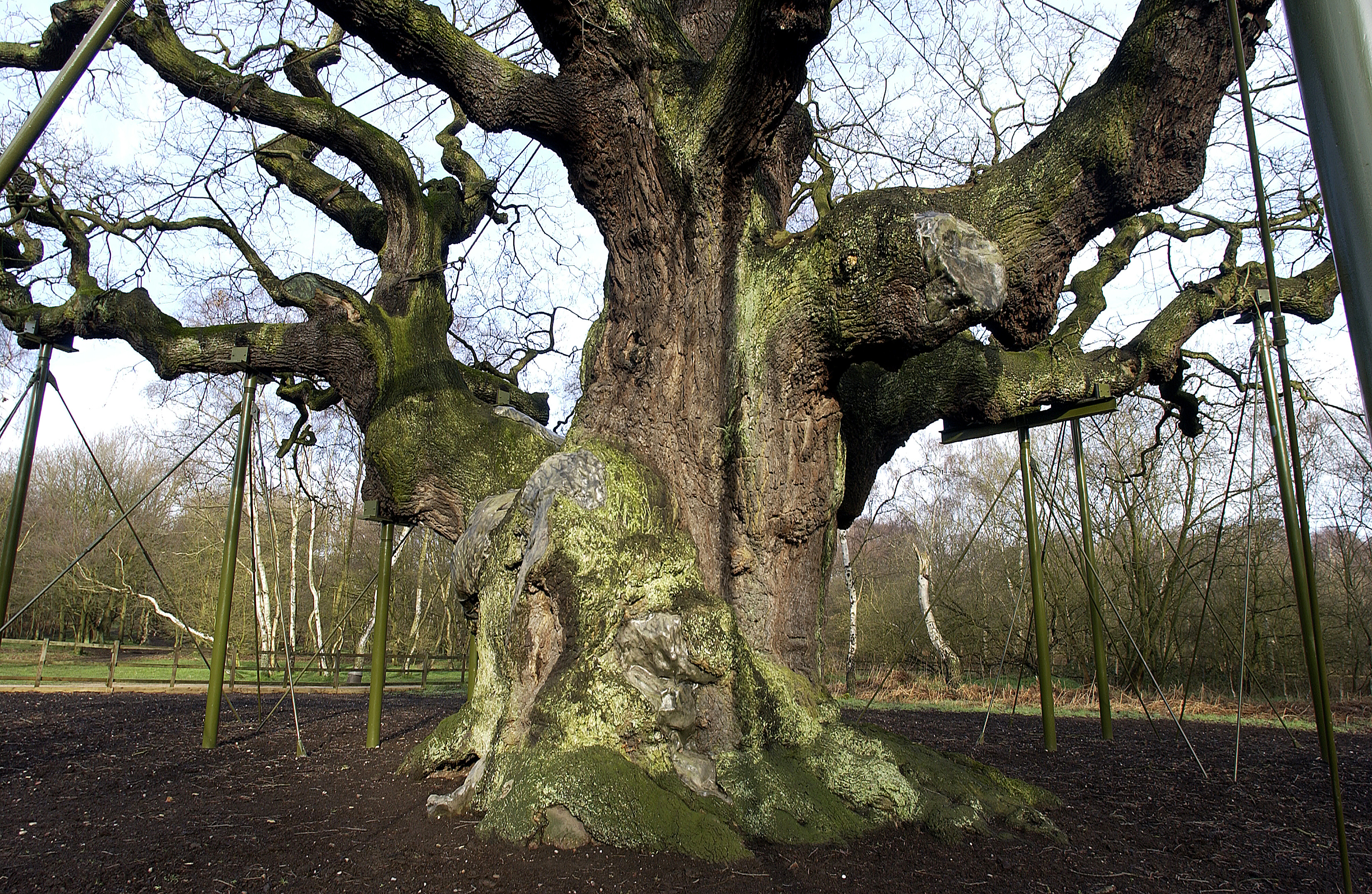
Pressmennan Elm - Photo credit Max Coleman

Pressmennan Elm with pollination bags - Photo credit Max Coleman
Native wych elms produce carpets of seedlings that spring up within weeks of the seed being dispersed. Wych elm is a tree of the upland fringe on lime-rich soil in northern and western Britain. Much of lowland England’s agricultural landscape was dominated by field elms (Ulmus minor) and hybrid elms (Ulmus × hollandica) growing in hedges. There is some debate about whether the field elm is a native tree as there is no compelling evidence that it is. Its occurrence in hedgerows is telling. This almost certainly reflects a history of planting that stems from how important elms were to our ancestors. Elm was lopped for fodder, and its wood has countless specific uses linked to its resistance to splitting and durability if kept constantly wet. This is why the first piped water ran through bored elm trunks that were butted together. The evidence, in the form of surviving sections of elm pipe, has been dug up in several UK cities.
The main thing you need to know about elms is that perhaps 100 million trees have been lost to the fungus that causes Dutch elm disease since the late 1960s, and the death toll continues to rise as the disease spreads to untouched areas in Scotland. Both the oldest and largest elms in the UK were recently lost in Scotland, not far from Inverness, around 2021. The Beauly Priory Elm was said to be an 800-year-old tree and Europe’s oldest elm. The Brahan Elm had a girth of over 7 m and was covered in a rich community of lichens. Both trees have now fallen and been cleared away.
The good news is that big elms have survived in all areas where elms were once common, the only problem is that they are so rare they tend to go unnoticed, and it takes effort to find them. When I was involved in a citizen science ‘Wych Hunt’ in 2022, looking for large wych elms in the Scottish Borders, with the help of the Borders Forest Trust, the public submitted details of about 50 trees and about 30 turned out to be big elms. This rather small number of trees came from a summer of searching a large area of prime elm country, so this gives a good indication of just how rare big elms are.

Wych elm at Cringletie House Hotel - Photo credit Max Coleman

The Brahan Elm was the largest wych elm in the UK in this photo the tree is dead - Photo credit Max Coleman
So, how should we judge the value of our remaining big elms? Although small elms are as numerous as ever, in the suitable areas, we certainly can’t let that cloud our judgement of the very few large survivors. Field elms sucker from surviving sections of the root and wych elms regenerate from seed, so, ironically, we now have more elms than before the disease arrived. Unfortunately, the disease is entrenched here and ebbs and flows over the years with ongoing evolution creating new variants. The fungus that causes disease is spread by elm bark beetles and these insects only feed on, and consequently infect, larger elms, meaning small elms avoid infection until they reach the age of roughly 20. But even these young elms are often seed-bearing before they are killed, and this just maintains a never-ending supply of small, susceptible elms.
Looking at the three categories of tree in the Ancient Tree Inventory – notable, veteran and ancient – there are no clearcut distinctions, and they represent a continuum. The only discernible difference between veteran and ancient is that ancient trees should be in the final third of their lives, but this remains a rather subjective judgement. The minimum size we accepted in our citizen science elm hunt was a girth of 2 m. This was because a tree of that size would have been mature and vulnerable to infection in the 1970s when disease arrived.
Thinking about trees in general, a tree with a 2 m girth is not unusual or impressive, so elms of this size are unremarkable and easily overlooked. They would fail to meet the single criterion for a notable tree that states they should be large in comparison to the trees around them. Yet, such a tree will be old compared with other elms. Also, such an elm would be interesting biologically, at its survival is a remarkably rare occurrence. However, it would be unlikely to have developed habitats produced by decay as an elm with a 2 m girth is still a relatively young and vigorous tree. But just on rarity alone, it seems reasonable to treat an elm of more than 2 m girth as notable.
Making the jump to veteran status is possible when the tree has obvious features of decay, such as heart rot, or limbs missing that have created rot holes that provide access to cavities. A tree of 2 m girth may have such features, although they are more likely to be seen in trees around 4 m girth.

Wych elm in limestone ravine woodland near lnchnadamph in Assynt in Northwest Scotland - photo credit Max Coleman
Making the jump to veteran status is possible when the tree has obvious features of decay, such as heart rot, or limbs missing that have created rot holes that provide access to cavities. A tree of 2 m girth may have such features, although they are more likely to be seen in trees around 4 m girth.
How would we define an ancient elm? I think that girth can be taken as a good approximation of age. The tree expert Alan Mitchell used a one inch to one year rule to estimate age from girth, so an elm with a girth of 5 m would be about 200 years old. If we estimate a typical lifespan for elm as 300 years, a 5 m tree is starting the final third of its life and, as mentioned, this is one definition of an ancient tree. In my experience, even elms of 4 m girth can have significant decay features, so 5 m should not be seen as a requirement and more of a general guide. Smaller trees, probably still above 4 m, that have developed obvious decay features should also be considered as potential ancient trees.
If this post has piqued your interest in elms, you can find out more in the recently published book Great British Elms – The remarkable story of an iconic tree and its return from the brink, published by the Royal Botanic Gardens Kew in 2024. Also, The Lost Elms by Mandy Haggith, published in 2025, is a tour de force on elms.
So, go on an elm hunt. Big elms are out there, hiding in plain sight.